KI, die Kreative Intelligenz jetzt in der neuesten Folge SMART&nerdy! Podcastfolge #23.
Ahmed Ramzi Salman, Auralia Medical Group (Titelbild: © AdobeStock | 172745118 | sveta)
Auralia Hospital’s PMS allows the management team to view real-time data regarding operations within the hospital, current staff levels, use of resources including medical equipment and rooms, bed occupancy, patient flow times and doctors’ work-loads. This allows hospital management to plan and improve the use of hospital resources by making decisions using complete datasets, resulting in better overall healthcare performance and patient outcomes. Thus the digitalisation based economic benefits add up with the undisputable benefits for patients in a smart hospital.
In retrospect, smart technology including artificial intelligence (AI) is a relatively new technological advancement compared to other technologies available to us. Despite that being the case, it has quickly become one of the most dominant technologies out there in recent years. Why is that? The answer revolves around three main factors – comfort, leisure and safety.
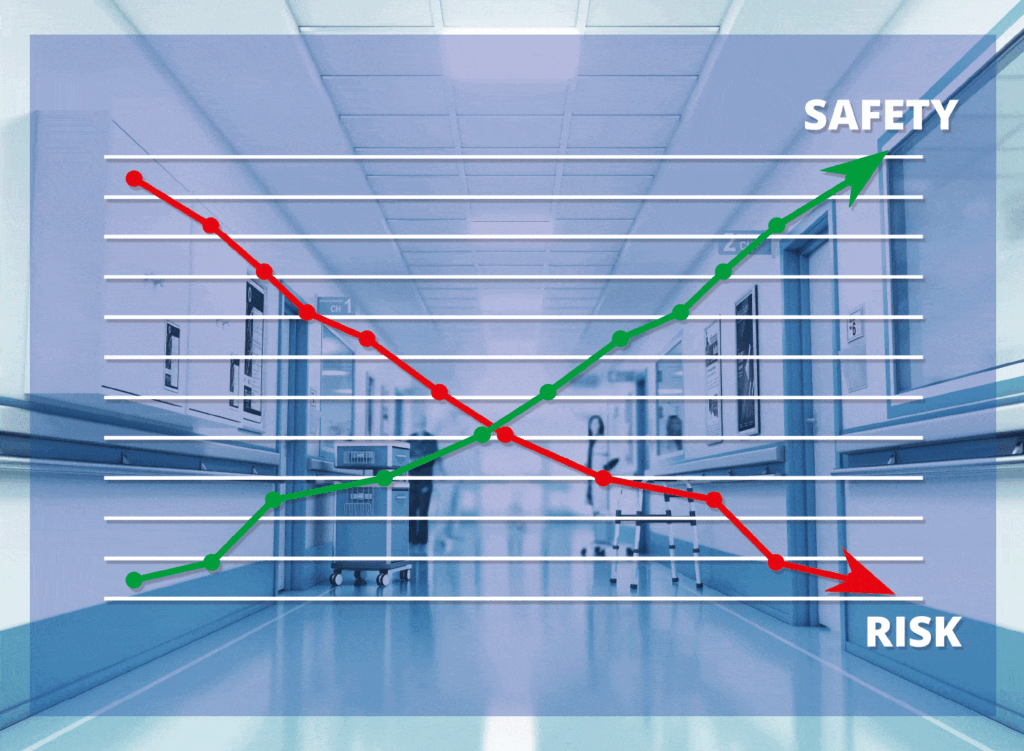
The interaction of smart tech and each of the three factors mentioned above could easily form an article of their own, or have their multiple intersections discussed and debated. But for the purpose of this article, I will focus solely on the safety factor. Indeed, only recently, smart technology and AI played a pivotal part in the roll-out of the first COVID-19 vaccines, allowing World Health Organisation medical teams to forecast the knock-on effects and consequences of the various options available to them in relation to “who should get the first vaccines”. The ability to use smart tech and AI to forecast that elderly and health compromised individuals were most at risk without vaccination undoubtedly saved countless lives.
Auralia Hospital, in Dublin, Ireland has become a leading example of how smart technology can be used to assist with, and even improve, patient safety. It was established in 2005 and is Irelands leading provider of cosmetic and weight loss surgery. The rise of smart tech within Auralia Hospital began in 2018, with the implementation of their cloud-based Customer Relationship Management (CRM) and Patient Management System (PMS). Wirelessly integrating their CRM and PMS with their website and phone lines resulted in all data from patient enquiries automatically being collected and collated into procedure, unit and staff member specific categories, resulting in faster, smoother and more efficient interactions with prospective patients. Additional integrations with their PMS and surgical theatre equipment allowed for live updates to the patients’ medical files throughout their admission, surgery, overnight stay and discharge, resulting in Auralia Hospital being capable of integrating a “paperless” policy in relation to patient medical files. The ability to set adjustable upper and lower limits within their PMS to various patient parameters including heart rate, blood pressure and haemoglobin levels allow for significantly earlier identification of post-operative complications. An earlier identification of a complication undoubtedly results in a significantly better outcome for the patient in almost all cases. A prime example of smart tech safety in action is exemplified in one particular patient instance where the patient underwent Vertical Sleeve Gastrectomy surgery, commonly known as a gastric sleeve. Intra-abdominal bleeding is a relatively rare but major risk of this surgery. Symptoms of a bleed include severe abdominal pain, firmness of the abdomen and difficulty breathing or shortness of breath. These symptoms tend to occur at a later stage of the bleed, sometimes several hours after the unidentified bleed has begun. In the instanced case, Auralia medical staff noted that in the earlier stages of an intra-abdominal bleed the patients haemoglobin levels consistently drop. Armed with this information, they set the haemoglobin parameters to allow a maximum decrease of 15 percent post-surgery, at which point a “red-flag” alert issues, as it did in this case, allowing the surgical team to intervene at a significantly earlier stage in the bleeding, resulting in the patient having a successful resolution.
In order to maximise the effectiveness and benefits of smart technology within hospitals, hospital management must also be smart. The Hospital’s PMS allows the management team to view real-time data regarding operations within the hospital, current staff levels, use of resources including medical equipment and rooms, bed occupancy, patient flow times and doctors’ work-loads. This allows hospital management to plan and improve the use of hospital resources by making decisions using complete datasets, resulting in better overall healthcare performance and patient outcomes. The economic benefits of carrying out these exercises should also not be underestimated. The ability to implement changes when it comes to increasing theatre occupancy, faster “turn-over” times of unoccupied beds and scheduling of specific procedures based upon equipment, theatre, staff and bed availability, results in a more financially beneficial flow and wise use of the available resources.
It took a worldwide pandemic for most offices or workspace environments to consider how unsafe the air we breathe indoors actually is. The reality is that 91 percent of the world’s population live in areas where the indoor air quality exceeds WHO permitted threat to health limits, resulting in an estimated 3.8 million premature deaths each year. In 2018 Auralia Hospital implemented the use of Eradic8 Viruskiller stand-alone air sterilizers in all rooms. Little did anybody then realise the extent of the benefit that these machines would provide only 12 months later. The air sterilisers clean the air by vacuuming it from the surrounding environment and then passing it through a series of filters, UV reactor chambers and sterilisers. In only one passing of air through the unit, 99.99 percent of airborne viruses (including COVID-19) and bacteria are destroyed along with dust, mould and fungi particles. Having implemented this technology prior to COVID-19, Auralia Hospital was fortunate in being in a unique position when the outbreak struck, insofar as already having this technology in place when it was needed most. Understandably, a worldwide shortage of this type of technology developed in 2019 and lasted for more than 12 months, resulting in many private hospitals having no choice but to temporarily close on safety grounds. Auralia Hospital successfully remained open throughout the pandemic and recorded zero Covid-19 outbreaks within the hospital. The absence of Covid-19 outbreaks in the Hospital can largely be attributed to the clean air technology deployed by the hospital at an early stage.
What was once considered solely to be a topic of science-fiction, is quietly making enormous strides within surgical theatres over the world. The world leader in robotic surgery at present is the Da Vinci System. Consultant Bariatric Surgeon at Auralia Hospital, Dr. Rodrigo Oliveira, has experienced the power of the Da Vinci system first hand. Traditional laparoscopic surgery requires the surgeon to stand over the patient and make several incisions across the patient’s abdomen, then pass long handled tools through these incisions to carry out the surgery, whilst viewing all aspects of the surgery on a large screen in the theatre via a small camera inside of the patient’s abdomen. The Da Vinci System allows the surgeon to sit at a computer console, close to the patient. From the console, the surgeon uses a series of hand movements, levers and joysticks to control the surgical equipment used to complete the surgery. This system allows for fewer and significantly smaller incisions to be made (less than 8mm) which results in an overall lower infection rate, faster wound healing and minimal scarring. The screens through which the surgeon views the patient’s abdomen deliver crystal clear 3D views of the surgical area magnified ten times greater than that of the human eye. The system translates every movement that the surgeon makes in real time, bending and rotating the surgical instruments which move like a human hand, but with a significantly grea- ter range of motion. Using tremor filtration technology results in each surgical instrument being moved with increased precision, resulting in lower surgical complication rates.
Building a smart hospital is by no means a small undertaking, but it will be a reality for most modern hospitals within the OECD over the next ten years. Getting the basics correct within a smart hospital creates the perfect foundation for future automation and advancement. For Auralia Hospital, this starts with the patient’s room. Siemens is of the same opinion, advising that the implementation of a smart hospital “begins at the room level”. Lighting, climate control and shading are all controlled through the one infrastructure, allowing for total room automation to suit the patient’s specific requirements. This may sound as though a patient can expect some form of hotel like experience with the ability to have their room “just the way they like it”. In the interests of full disclosure, yes – that is a factor that smart hospitals consider. Patients are more demanding and have higher expectations than ever, particularly when attending a private hospital, for which they will have paid for the privilege to be in. However, there is far more to this than just keeping a patient happy. Clinical research has proven that the lighting level within a room, the temperature of the room and the air quality within the room all play a key role in the successful and speedy recovery of a patient. With this in mind, Auralia hospital operates entirely different parameters in the general wards compared to the High Dependency Unit, the theatres and most importantly, the Post-operative Acute Care Unit (PACU) where patients are initially cared for and monitored immediately post-surgery. Heated beds, blankets and controlled air systems work hand in hand to assist the medical team in a safer and more efficient recovery process. In conclusion, smart hospitals are no longer a topic of fantasy, but a fast-growing reality that more and more people worldwide will likely experience at some point in their lives. Auralia Hospital is, and will continue to be, leading the way in the implementation of smart technology within the healthcare industry. Using smart technology, Auralia Hospital ensures that patients receive a more streamlined healthcare experience from admission to the time of discharge, whilst ensuring that all potential risks are minimised in an automated and efficient manner while providing the patient with a remarkably comfortable experience. Auralia Hospital sees itself as an important contributor to the future of smart healthcare in Europe. Simply put, going smart is good business where everyone wins, not least the most important party – the patient.