KI, die Kreative Intelligenz jetzt in der neuesten Folge SMART&nerdy! Podcastfolge #23.
Sean Tan, Insect Feed Technologies
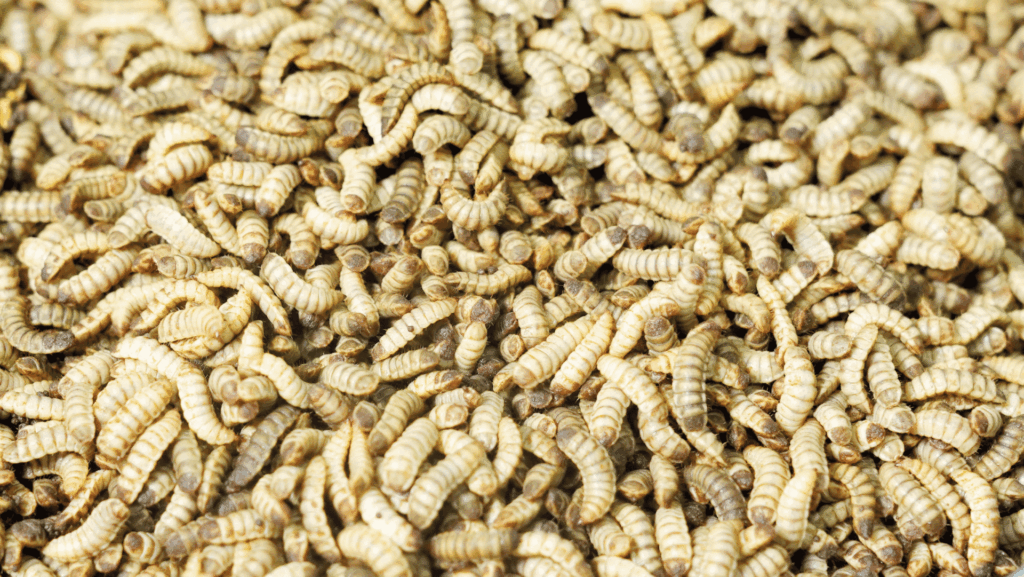
(Titelbild: © Inscet Feed Technologies)
Founded in 2020, Insect Feed Technologies is a Singapore-based company with a mission to feed the growing global population. They are working to offset carbon by diverting food waste from landfills and replacing unsustainable feed and fertiliser in the ecosystem. Through upcycling food waste, they produce nutritious black soldier fly larvae as a sustainable source of insect-based protein for animal feed, alongside frass fertiliser for soil and plants.
Insect Feed Technologies currently manages the largest black solider fly operations in Singapore, and aims to accelerate sustainable food production globally through insect farming. Being an advanced manufacturing and insect biotechnology company, they leverage on technology to repurpose food waste into high-quality insect-based protein for animal feed and frass fertiliser for agriculture. In doing so, this process creates a circular economy by offsetting the carbon footprint of businesses by diverting food waste from landfills, and replacing unsustainable feed and fertiliser in the food ecosystem.
Studies predict there will be around ten billion people on earth by 2050, resulting in three billion more mouths to feed. Having to produce almost 60 percent more food, an enormous challenge for the food industry is created to match this ever-increasing demand for meat. At this rate, global meat production would have to do more than just keep pace. Farming industries require protein to help animals grow, however, the two largest sources of feed (fishmeal and soybean) currently face insufficient production. Not only are these supply sources struggling to meet the growing demand, they are also decreasing due to limited land and/or fluctuations in fishing populations and yields. Ultimately, the use of insects as livestock feed can enhance sustainability by transforming low-value organic waste (such as, fruits, vegetables, and even manure) into high-quality feed, addressing the gap of insufficient feed in the market.
These global challenges were the motivation to start Insect Feed Technologies. Founded in March 2020 at the height of COVID-19, the company kickstarted operations in a pilot research center at CleanTech Park in Jurong Innovation District, Singapore to carry out its first R&D tests and optimisation in the production cycle of insects. In particular, the black soldier fly (Hermetia illucens) serves as a valuable source of nutrition for animals with plentiful health benefits.
Black soldier flies are small, harmless insects with the potential to provide promising solutions to the two modern agriculture growing problems: high cost of animal feed and disposal of large amounts of organic waste, ranging from animal waste to food scraps. However, the industry still faces an issue regarding conversion efficiency with many insect farming start-ups only being able to manage high-nutrient food waste substrates, such as brewery grains and soybean residue, compared to agricultural waste substrates. Yet, this is only a tiny fraction of the sheer amount of waste the food production industry produces. For example, it is estimated that several million tons of palm oil waste is produced annually, including empty fruit bunches, mesocarp fibers, and palm oil mill effluent. This waste not only creates environmental and health hazards, but also results in a loss of valuable resources. While BSF larvae provide a solution to this problem, its effectiveness is still limited due to the high fibrous content and low nutrient availability. Thus, Insect Feed Technologies’ innovative technology and expertise in using enzymes makes it possible to pre-treat waste including agri-waste that makes up a significantly majority of organic waste produced.
Black soldier flies are highly efficient insects to use for animal feed. Besides having a short lifespan, they are one of the safest insects to farm. Primarily feeding only in its larvae stage, the adults feed on liquids if not nothing. Unlike houseflies or mosquitoes, they do not bite or spread diseases. With the right conditions in place, the fly-breeding process can efficiently valorise waste into protein.
Insect Feed Technologies thus harvests these insects in their larvae stage, which is their highest point of nutritional content, before drying and processing them into insect protein, meal and oil. Containing at least 50 percent crude protein, up to 35 percent lipids and have an amino acid profile similar to that of fishmeal, the dried larvae is essentially a source of protein block in feed for animals. Additionally, the insects are fed with organic waste, providing an alternative waste management solution that benefits the environment and the wider ecosystem as a whole. In short, the insects are either converted into compost for soil and plant nutrition, or are harvested for animal feed.
In order to ensure the black solider fly industry remains prosperous, it is essential to invest in research and development. Insect Feed Technologies has invested more than USD 1.5M over the last two years in R&D and operating initiatives to stay competitive. Their lab and field trials are conducted with leading research and government institutions to push the boundaries of scientific research surrounding black soldier flies. These partnerships are formed to demonstrate and optimise product performances in animal and plant nutrition, having notable partners such as the Agency for Science, Technology and Research Singapore (A*STAR), Republic Polytechnic, and the Singapore Food Agency. The focus of their R&D lies in improving efficiency and productivity within the black solider fly industry, and aims to identify new uses for larvae products derived from these insects. Through continual investment in zootechnical and entomological research, they gain a deeper understanding into this insect’s life cycle, allowing the company to develop commercially viable technologies to replicate the natural conditions of their habitat. To create innovative and nutritious feed required for larvae at each growth stage, substrate optimisation research to design and develop feed recipes that will meet the nutritional needs of larvae at every stage of their growth is crucial. There are more than five types of organic waste substrates, including food (for example, brewery grains and bean curd residue) and agriwaste (for example, fruit and other palm oil co-products), to be evaluated with more than 100 permutations of recipes.
By developing an array of systems encompassing hardware and software innovation, their deep expertise in advanced manufacturing makes it possible to facilitate farming insects in an efficient, cost-effective and consistent method on an industrial scale. Insect Feed Technologies uses more than 50 unique IoT-enabled sensors for consistent monitoring of environment parameters and maintaining of optimal conditions for insects to thrive. Coupled with automated processing, their unique and proprietary production requires little human intervention in feeding and harvesting the larvae.
After just two years, Insect Feed Technologies completed and launched Singapore’s first insect-fed shrimp and successfully formulated the country’s first insect-based shrimp feed, as part of a research collaboration with Republic Polytechnic. Up to 40 percent of fishmeal present in the shrimp feed was replaced by IFT’s insect protein and trialled to produce tasty and sustainably farmed shrimp.
To conclude, insect farming is seen as a viable option to transform organic waste materials into two product streams: insect protein and frass fertiliser. Meanwhile, the Insect Feed market is estimated to reach a value of USD 17.4 billion by 2033, registering a CAGR of 20.9 percent during the forecast period from 2023 to 2033. It would therefore be ideal for the government to initiate various policies to increase the production of Insect Feed to aid in the production of high-quality protein.
According to current assumptions, China is projected to lead the global market share by 2033, while India is estimated to hold a CAGR of 24.1% and a valuation of 488.8M. This market assessment clearly indicates that Insect Feed could be the hope and solution for global challenges in the future.