KI, die Kreative Intelligenz jetzt in der neuesten Folge SMART&nerdy! Podcastfolge #23.
[vc_row][vc_column][vc_custom_heading text=“An ethical business model“ font_container=“tag:h1|font_size:48|text_align:left“ use_theme_fonts=“yes“ css=“.vc_custom_1615462011163{margin-top: -25px !important;}“][vc_custom_heading text=“Developing, producing and selling ethical and commercially successful smartphones“ font_container=“tag:h2|font_size:28|text_align:left|color:%23676b6d“ use_theme_fonts=“yes“ css=“.vc_custom_1615462021584{padding-bottom: 10px !important;}“][vc_column_text]
Ioiana Pires Luncheon, Fairphone Amsterdam
[/vc_column_text][ultimate_spacer height=“15″ height_on_tabs=“15″ height_on_tabs_portrait=“15″ height_on_mob_landscape=“15″ height_on_mob=“15″][/vc_column][/vc_row][vc_row][vc_column][vc_custom_heading text=“Kurz & Bündig“ font_container=“tag:h2|font_size:34|text_align:left“ use_theme_fonts=“yes“ css=“.vc_custom_1598268967432{margin-top: -25px !important;}“ el_class=“box-headline“][vc_row_inner el_class=“box-content-wrapper“][vc_column_inner][vc_column_text]Fairphone is developing, producing and selling smartphones that are ethical and commercially successful. The successful newcomer in mobile communications uncover the social and environmental issues behind electronics and gains more and more supporters, from customer and traditional producers. Commercial and ethical success can be combined – an example for the digital economy.[/vc_column_text][/vc_column_inner][/vc_row_inner][/vc_column][/vc_row][vc_row css=“.vc_custom_1519752670572{margin-top: -10px !important;}“][vc_column][ultimate_spacer height=“30″ height_on_tabs=“15″ height_on_tabs_portrait=“15″ height_on_mob_landscape=“15″ height_on_mob=“15″][vc_column_text]More and more people realize the importance of sustainability. With everything that is happened in the last year due to COVID-19, even more people and businesses are realizing its importance. By developing, producing and selling smartphones that are ethical and commercially successful, Fairphone is setting an example for the industry. IM+io has spoken to the successful company from the Netherlands.[/vc_column_text][/vc_column][/vc_row][vc_row][vc_column][vc_custom_heading text=“IM+io: What is the unique approach of Fairphone?“ font_container=“tag:h4|text_align:left“][vc_column_text]IPL: We manufacture a smartphone and in doing so, we uncover the social and environmental issues behind electronics. Our offering is quite unique but there are other companies trying to achieve similar goals.[/vc_column_text][vc_custom_heading text=“IM+io: How are your values implemented in your business model?“ font_container=“tag:h4|text_align:left“][vc_column_text]IPL: We raise awareness around issues in the industry by uncovering the complex supply chains behind electronic products and communicate transparently about it to a wide group of people. By developing, producing and selling smartphones that are ethical and commercially successful, we are setting an example for the industry. We create followers by motivating the industry to make caring for people and the planet as standard part of doing business. We want to change the industry into a sector that cares for people and the planet and we do this by proving that it is possible to do things differently.[/vc_column_text][vc_custom_heading text=“IM+io: Are there any visible changes in the electronics industry or similar approaches to Fairphones sustainability method?“ font_container=“tag:h4|text_align:left“][vc_column_text]IPL: We are seeing it more and more each year. We are seeing big players wanting to work with us, companies like Orange, Vodafone and Glencore. This shows that the industry is listening and is getting involved with our mission.[/vc_column_text][vc_custom_heading text=“IM+io: Where exactly do the changes come from?“ font_container=“tag:h4|text_align:left“][vc_column_text]IPL: As I mentioned, it is coming from partners, but also suppliers, the market and customers. With the launch of this program, customers are encouraged to send back their old modules – free of charge, whatever their condition. The aim of the program is to give these modules a second life wherever possible, whether that is through reuse or refurbishment. Where the condition of the modules means we cannot give them a second life we can recycle them much more efficiently by getting modules back in larger volumes, so it is better for the environment either way. Our Service Centers were so impressed by the changes we’ve made, we are now working together to see how we can expand our current program to include other industry players.[/vc_column_text][vc_custom_heading text=“IM+io Sustainability is often seen as environment protection. But you have a political agenda as well, by trying to improve working conditions. How do you want to achieve that?“ font_container=“tag:h4|text_align:left“][vc_column_text]IPL: As an individual company or single player or even as the electronics industry, preventing humanitarian crises is not possible, but what we can do is improve the supply chain and inspire our sector and other sectors to do the same. For example, we launched the Fair Cobalt Alliance (FCA) last year, which is an action platform that brings together major industry players that see Artisanal and small-scale mining (ASM) as a potential driver for local development if done sustainably, because it creates a livelihood for many people. Cobalt is indeed majorly coming from the Democratic Republic of Congo, where ASM is often associated with hazardous working conditions, child labor, and limited access to legitimate, transparent markets – falling well below the expectations of buyers in international markets of what decent work looks like for miners. To address these deep-rooted problems is not the responsibility of one sector alone or any individual company – there needs to be systemic change. The FCA program is designed to drive impact both on-site and offsite.[/vc_column_text][vc_custom_heading text=“IM+io: What is your opinion regarding an “European supply chain law/act”, a call for more sustainability and labour rights?“ font_container=“tag:h4|text_align:left“][vc_column_text]IPL: We support the increasing awareness and push for transparent and responsible sourcing of minerals in Europe, for which legislation can be an important tool. Legislation provides an important driver and signal that sustainability is taken seriously and provides an incentive for companies to start researching their supply chain and therefore, drive more transparency in the industry.[/vc_column_text][vc_single_image image=“25281″ img_size=“full“][vc_custom_heading text=“IM+io: Some of your competitors seem to think of your sustainability model as an open door for increasing market regulations. What do you make of that?“ font_container=“tag:h4|text_align:left“][vc_column_text]IPL: We cannot really answer for other players in the market, but we do think that It’s important to keep in mind the impact and effectiveness of the sustainable business approach. We need to focus on the effects which regulation generates on the ground and focus on creating the foreseen impact. Things such as costs of compliance should be spread between parties along the supply chain, but so should its benefits. We should also focus on creating positive incentives for systemic changes and structural solutions (for example not only looking at it from compliance or risk perspective).[/vc_column_text][vc_custom_heading text=“IM+io: Values do have a price. How much does Fairphone devices differ from standard products in the market?“ font_container=“tag:h4|text_align:left“][vc_column_text]IPL: Our current model, the Fairphone 3+, is a mid-range phone but it costs more than the average mid-range phone because of the work we do around sustainability, users pay a premium for it.[/vc_column_text][vc_custom_heading text=“IM+io: Do you think that social entrepreneurship can be a viable business model?“ font_container=“tag:h4|text_align:left“][vc_column_text]IPL: Commercial success is crucial to achieving this wider impact. The more phones we sell, the more we show there’s demand for ethical phones, the more we prove our business model, gain influence in the industry and inspire like-minded people and organizations to take action.[/vc_column_text][vc_custom_heading text=“IM+io: With your sustainability approach in mind, how successful do you think you are right now?“ font_container=“tag:h4|text_align:left“][vc_column_text]IPL: In 2020, despite the challenges around Coronavirus, we were able to double our sales, each year we sell more and more phones, so I would say that we are a successful example of the ethical business model.[/vc_column_text][vc_custom_heading text=“IM+io: Is the COVID-19 crisis a boost for Fairphone?“ font_container=“tag:h4|text_align:left“][vc_column_text]IPL: Not really, what we are seeing is that each year, more and more people realize the importance of sustainability. With everything that is happened in the last year, even more people and businesses are realizing its importance. In 2020, after the sales drop related to COVID-19 where many of our retail partners had to close their stores, we have seen sales steadily picking up again. Although we are back on a growth path, the situation remains uncertain as the economic impact of the pandemic is still to be seen.[/vc_column_text][vc_custom_heading text=“IM+io: Do you get support from players in politics?“ font_container=“tag:h4|text_align:left“][vc_column_text]IPL: Yes, for example, in France, when the Government started working on putting their Repairability Index together, they asked us to consult on the project, which we did.[/vc_column_text][vc_custom_heading text=“IM+io: In 2020, your goal was to recycle 20,000 mobile devices. How did that play out?“ font_container=“tag:h4|text_align:left“][vc_column_text]IPL: We were able to recycle over 17,000 phones from our European take-back program last year. In addition, we recycled more than 1,500 phones as well as 5,000 kg batteries from Africa in cooperation with the company Closing the Loop. Overall, this means that we recycled a number of phones which equals about 20 percent of our phone sales and 44 percent of the weight of phones we put on the market. We have seen that financial incentives play a big role for consumers to return their phones, even when they no longer have value on the secondhand market.[/vc_column_text][vc_custom_heading text=“What is your take on how to increase efforts to recycle more mobile phones?“ font_container=“tag:h4|text_align:left“][vc_column_text]IPL:
There are several approaches that should be considered to improve take back for recycling:
• Staying owner of future waste/resources through circular business models.
• Getting consumers to return their used phones by incentivizing take-back in the European market. This could, for example, be a system in which consumers can earn credits for every electronic product they recycle which can then be used to get discount codes or similar. We are currently running a pilot on this together with Everledger.
• Educating consumers on their right to return electronic products for free under the WEEE.
• Making a business case for recycling, through internalizing externalities (negative social and environmental impacts) of virgin materials into the resource price.
• Creating more awareness among consumers about the consequences (more virgin material production with environmental and social impacts) of when phones are kept in drawers.
• Trust in data destruction methods should be increased. Often people don’t believe that their data is safe when they hand in a broken phone.
• Data recovery methods (for example for photos which are on a broken phone) should be affordable, accessible and involve recycling the phone directly afterwards. People are likely to keep their phone when they still have ‘lost’ photos on them that they want to recover one day.
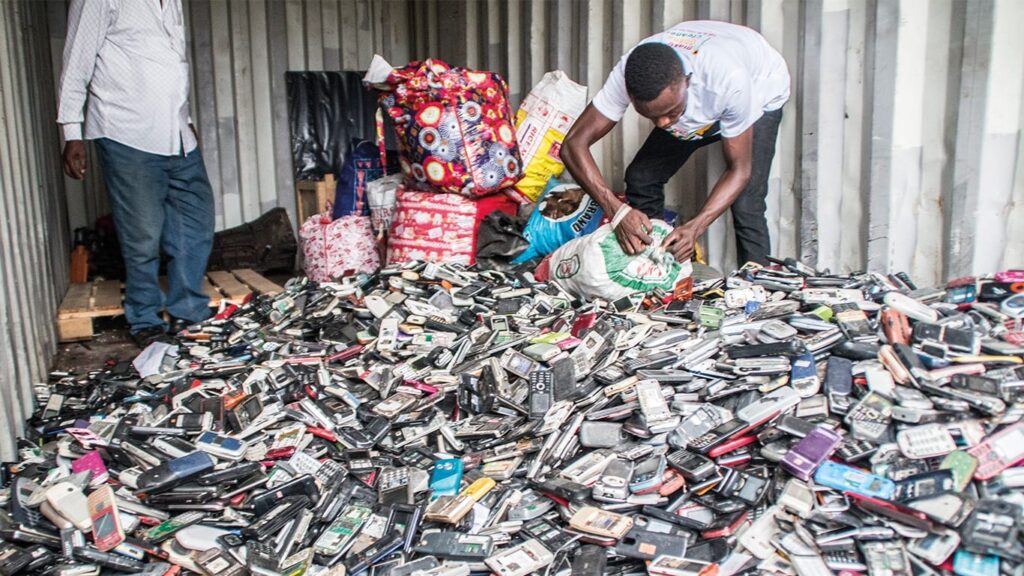
• Acknowledging that our current system fails and often secondhand phones that aren’t working properly are exported to countries with poor recycling systems. In those countries, electronics are widely inefficiently recycled in the informal sector with severe environmental and health impacts through toxic materials used in the process and the burning of e-waste. Therefore, firstly, waste exports have to be prevented. However, phones that are still working will also become e-waste at a certain point and the e-waste which has already accumulated in these countries needs efficient and environmentally sound recycling. In the short term, we should therefore consider recycling old phones from countries with poor recycling infrastructure and at the same time support the creation of a decent recycling system in those countries and involve the people who are currently part of the informal sector.[/vc_column_text][vc_custom_heading text=“IM+io: How expensive is the recycling process for phones?“ font_container=“tag:h4|text_align:left“][vc_column_text]IPL: This is a question we are currently researching as well. What we know is that only phones which are remarketed, thus, get a second life and pay for themselves in terms of collection through shipping them by post. However, as a ton of mobile phones contains more gold than a ton of gold ore, we believe that there should be a way to make a business case for recycling old phones.[/vc_column_text][vc_custom_heading text=“IM+io: What are the next steps and plans of Fairphone? What can customers expect in the near future?“ font_container=“tag:h4|text_align:left“][vc_column_text]IPL: They can expect us to increase our industry presence. This means targeting a larger audience and boosting our position in the industry. We want to really maximize the positive impact we can make throughout the industry.
(Bildquelle: © Fairphone)[/vc_column_text][vc_single_image image=“25282″ img_size=“full“][/vc_column][/vc_row][vc_row][vc_column][ult_dualbutton btn_hover_style=“Style 2″ btn_border_style=“solid“ btn_color_border=“#ffffff“ btn_border_size=“2″ btn_alignment=“left“ dual_resp=“off“ button1_text=“Einzelheft kaufen“ icon_link=“url:https%3A%2F%2Fwww.im-io.de%2Fproduct%2Flerngroesse-eins%2F|title:Lerngr%C3%B6sse%20Eins“ btn1_background_color=“#f3f3f3″ btn1_bghovercolor=“#f07d00″ icon=“Defaults-book“ icon_size=“22″ icon_color=“#f07d00″ icon_hover_color=“#ffffff“ button2_text=“Jetzt abonnieren“ btn_icon_link=“url:https%3A%2F%2Fwww.aws-institut.de%2Fim-io%2Fabo%2F|title:Abo||“ btn2_background_color=“#f3f3f3″ btn2_bghovercolor=“#f07d00″ btn_icon=“Defaults-chevron-right“ btn_icon_size=“22″ btn_icon_color=“#f07d00″ btn_iconhover_color=“#ffffff“ divider_text=“oder“ divider_text_color=“#f07d00″ divider_bg_color=“#ffffff“ btn1_text_color=“#f07d00″ btn1_text_hovercolor=“#ffffff“ btn2_text_color=“#f07d00″ btn2_text_hovercolor=“#ffffff“ title_font_size=“desktop:20px;“ btn_border_radius=“30″ title_line_ht=“desktop:22px;“ btn_width=“280″][/vc_column][/vc_row]