KI, die Kreative Intelligenz jetzt in der neuesten Folge SMART&nerdy! Podcastfolge #23.
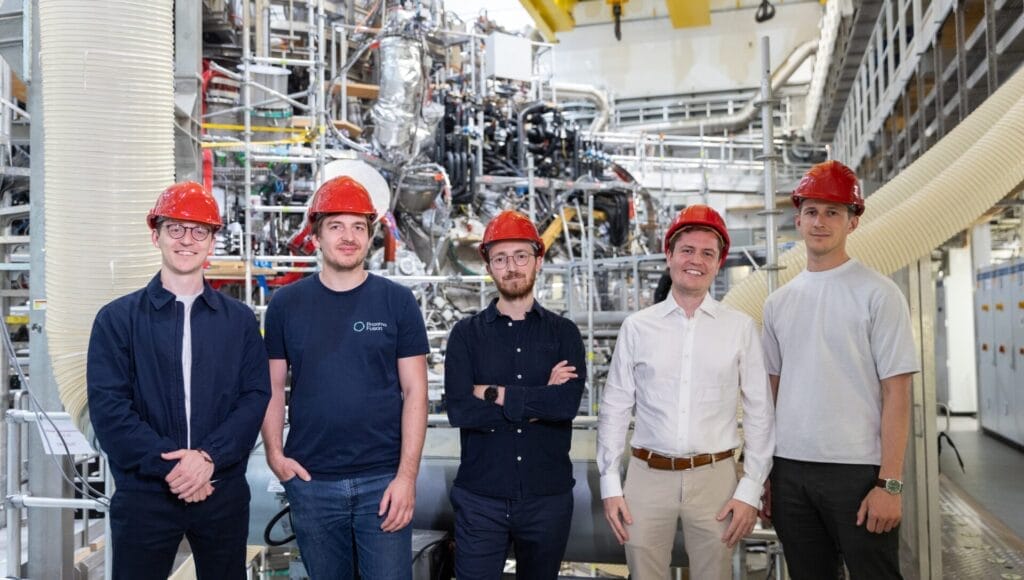
Martin Kubie, Proxima Fusion in conversation with Milena Milivojevic, IM+io
Proxima Fusion, aims to make fusion energy a reliable power source through stellarator technology. The company, founded by former Max Planck and MIT researchers, focuses on simulation-driven design and strong European partnerships with institutes like Max Planck and the Paul Scherrer Institute. Key goals include a prototype magnet by 2027 and a demonstration reactor by 2031 to enable continuous, clean energy generation across Europe.
In a quiet lab far from any launchpad, engineers chart their own kind of voyage. Their destination is not a distant planet but a star contained within magnetic fields. Around them, coils hum like engines preparing for takeoff, guiding plasma instead of spacecraft. Each simulation maps uncharted territory in the physics of controlled fusion. Could humanity’s next great frontier be found not in the cosmos, but in the power of its own stars?
MK: I am Martin Kubie. I grew up in Scotland, but half my family is Czech, so I see myself as European at heart. I was always fascinated by engineering and wanted to work on impactful things like transport and energy. I studied mechanical engineering, then started in industrial R&D at a British technology company.
After that, I got my dream job in Formula One, working at McLaren nearly four years on performance modeling of car systems. It was amazing, even though I had been a Ferrari fan. Later, I moved to California to work at Google X, their research lab for projects like self-driving cars and renewable energy systems. I joined their aviation team, which became Wing, a delivery drone company. I led the simulation team there, and over time my career became all about simulation.
After seven years I loved the work, but I wanted something new, something I felt more connected to and I wanted to move back to Europe. While exploring options, I got really lucky, and that’s where the Proxima story begins.
MK: In 2022 there was a big moment around a machine in Germany called Wendelstein 7-X, or W7-X, built in northern Germany. The project was launched in the mid-1990s, took about 20 years to design and construct, cost around one and a half billion euros, and it became operational in 2015. It is special because it is a stellarator, one of several concepts for fusion energy. Stellarators had long been seen as interesting but mainly experimental.
When the Max Planck Institute completed W7-X and operated it successfully in 2015, it was a breakthrough. In 2022 they showed it met all performance targets, proving that the concept works. That was when I got lucky. A close friend of mine was a plasma physics postdoc at the Max Planck Institute for Plasma Physics. He and other postdocs from Max Planck and MIT felt it was time to take the next step.
At the same time, two major problems that had limited the machine were being solved: performance optimization and magnet technology. The new generation of high-performance magnets made it possible to think about commercializing the concept. The group realized this next step could not happen within a public institution and had to be done as a startup to move faster and attract capital.
My background was in simulation, and these machines can only be designed through simulation. In the past you needed supercomputers for that, but today cloud computing makes it possible. They needed an engineer with simulation experience, I was introduced, and that is how I joined. We incorporated the company, raised our first venture capital, and began to define our vision.
MK: Our vision for Proxima Fusion was shaped by three main ideas. First, we believed that developing stellarator-based fusion energy is best done in Europe. The most advanced experiments and expertise are here, so it made sense to build on that foundation rather than move to Silicon Valley or China.
Second, a startup cannot achieve this alone. We decided to create strong partnerships with leading institutes. We work closely with the Max Planck Institute for Plasma Physics, where much of this research began, and with the Paul Scherrer Institute in Switzerland, which has deep expertise in superconducting magnets. We also collaborate with the UK Atomic Energy Authority, the Karlsruhe Institute of Technology, and other top research groups across Europe, as well as industrial partners who help us move faster. When we started we were eight people, now we are about 100, but we still rely on collaboration to scale.
Third, we follow a simulation-first approach. With today’s computing power we can design faster and more precisely. Instead of optimizing plasma, magnets, and systems separately, our tools allow us to design them together from the start. This holistic method lets us move quickly and efficiently. Using this approach we published a conceptual design paper that received significant attention, and the head of MIT’s Plasma Fusion Group called it the biggest breakthrough in ten years. The recognition helped us raise more funding, around 130 million euros, bringing the total to about 200 million. We are still small for the fusion field, but it marked a major step forward for us.
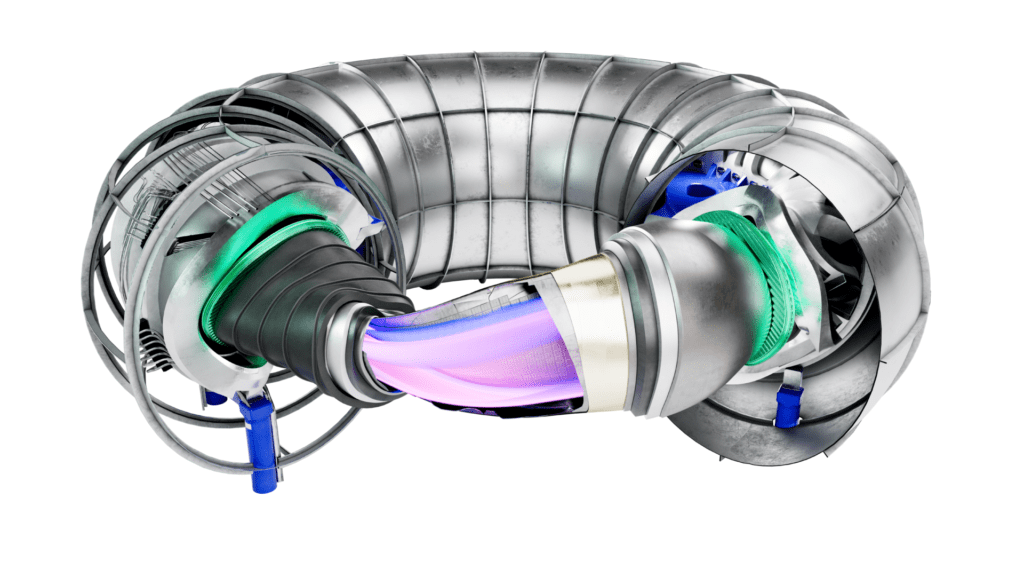
MK: There are two main families of fusion: magnetic confinement and inertial confinement. In magnetic confinement, a large volume of plasma is suspended inside a magnetic field because it reaches about 100 million degrees and cannot touch any material. Powerful magnets isolate and allow heating the plasma to fusion conditions. The goal is to design the magnetic cage so it keeps the energy contained. The stellarator design improves this confinement performance.
In inertial confinement, the approach is almost the opposite. Instead of holding plasma in a large machine, very small amounts of fuel are heated extremely fast, usually with lasers, creating brief pulses of fusion power. Laser-based systems currently hold the record for energy output, but they depend on specialized and costly infrastructure that has been developed for high-energy research applications.
Magnetic confinement aims to build a machine you can turn on and let run continuously. Lasers achieve high power in short bursts, but magnetic confinement achieves higher sustained power. Proxima focuses entirely on magnetic confinement, as most experts believe it is the long-term solution for scaling to power plants.
Within this family there are two subtypes: tokamaks and stellarators. Both have a donut-shaped plasma, but stellarators have a more complex geometry. Their advantage is stability. Tokamaks work in pulses and can suffer from disruptions that may severely damage the machine. Stellarators, once designed and built, can operate continuously, which is what Wendelstein 7-X demonstrated. With modern computing and design tools, it is now possible to optimize these complex systems efficiently. We believe stellarators are the best path to create continuous, stable fusion power for reliable baseload energy.
MK: We have three main milestones. The first was to develop and publish a concept for a power plant, which we completed early this year. The next is building a model coil, a prototype magnet. A stellarator uses about 30 to 40 magnets, and their shape and strength define performance. Even a small improvement in magnet strength leads to a large increase in fusion power.
There is a new class of high temperature superconductors, or HTS, which were first demonstrated in a fusion relevant magnet by a team at MIT in 2021 for a tokamak. Our goal is to adapt this technology for a stellarator and show it works by 2027. We have already completed several intermediate tests, and results are promising. Our partnership with the Paul Scherrer Institute in Switzerland, which has long experience in magnet technology, is a big advantage.
The demonstrator machine, planned for 2031, will combine the advances in magnet technology with new optimization methods for the plasma shape. The biggest challenge is the timeline. The technology itself looks solid, and we have excellent partners, but building such a large facility in record time is demanding. As a startup we can move faster than public institutions, yet we still face practical challenges like construction, supply chains, and equipment. Design work is progressing well, and we expect a major design review at the end of the year.
MK: It is reasonable and very aggressive. I am careful because this is high risk R&D. What gives me confidence is that two key players have shown it is possible. In the United States there is a company called Commonwealth Fusion Systems. They built a magnet on the timeline we are targeting and are building a machine on a similar timeline that few believed possible. It is not finished yet, but things look good, and it will be the most powerful tokamak ever built. We believe a stellarator is the right path, but that shows ambitious projects are possible. China is also moving very fast. There was an overview of a new research facility for fusion built over the past five years. It is enormous, advanced, and built at a speed few thought possible. So I do think it is possible. It is extremely aggressive, but if we do not manage it, Europe will fall a long way behind.
MK:The amount of money going into fusion in the US from private investors and in China from the government is enormous. Europe is not doing that right now. We need a significantly more ambitious model. The good news is that in Germany this is changing fast. When Friedrich Merz became Chancellor of Germany, he referenced the coalition agreement, which states that Germany will be home to the first fusion power plant. Part of the new industrial strategy with the debt financing the country raised is going specifically toward fusion. Bavaria is putting funding into fusion to create a fusion valley. It is changing quickly and the ambition is there. I am very happy to see that in Germany the political climate and ambition are moving. It is amazing to see.
MK: I will always take investment and pressure if it makes success more likely. I spent seven years in Silicon Valley. No one there talks about what if this does not work. It is always what if it does work. I am a proud European, but sometimes I feel there is too much of what if you fail, would that be embarrassing, maybe you should not try. One thing to learn from America is the attitude to try because the opportunity is enormous. I also see the risk of not trying. If we do not try we will end up buying these machines from America and China.
MK: Fusion cannot solve climate change today. We have a long way to go in scaling and deployment. It also cannot solve all energy needs. The main reason is cost. Solar will always be very cheap. What fusion can do is what other forms cannot. First, clean baseload. When the sun is not shining and the wind is not blowing you still need energy. Fusion is the perfect replacement for fossil fuels and for fission. Second, it removes dependence on natural resources. Gas plants need gas, coal plants need coal, nuclear fission plants need uranium. For fusion the amount of fuel is so small that the key is technology. It takes us to a world where access to energy equals access to technology. If you want long term energy stability and security without fossil fuels, in my view you need fusion.
MK: In the short term most of the technology risk is concentrated on our advanced magnet technology. It is a simplification, but it is the most important strategic R&D for us. My responsibilities are across engineering, but most of my time is on magnets because they are so important and it is our biggest team. On the organizational side we have gone from eight people and seven million euros to over 100 people, three countries and 200 million euros in two years. That scaling is challenging. Some startups grow even faster, but as a founder the responsibility grows quickly. What started as exciting is now even more fulfilling, and it’s that sense of growth and responsibility that keeps it fun.
MK: We have an amazing team of highly skilled and motivated people. We have brought in experts in manufacturing, magnet technology, and fusion systems. For example, Jenny, who leads the design of our demonstrator called Alpha, previously led design for the British government’s national fusion power plant project. Our head of magnets developed similar technology at another startup, and our chief manufacturing officer led the Falcon 9 rockets at SpaceX and previously was a manufacturing leader at BMW. Once you have a few great people, others want to join them.
At the same time, our younger engineers are equally impressive. Seeing everyone collaborate and solve problems together is inspiring and keeps the company culture strong. That collaboration is how we handle scaling. We also have a strong people team, led by Marija, who helps ensure structure and balance. Still, much of our progress happens organically. We encourage internal mobility and let people identify where they can have the most impact. At this speed, clarity has to come from individuals as much as from management.
MK: In the near term we are focused on key technical milestones, especially in magnet technology. Each week new hardware arrives at our labs, from simple components to highly advanced instruments, and these projects will prove that our magnet approach works. On the design side we have a major review scheduled for the end of the year, which will be an important step for the demonstrator.
In the medium term I want Proxima to be recognized internationally as one of the leading fusion companies. If there are national champions in China and the United States, Proxima should be the clear European counterpart, the “Airbus of fusion.”
In the long term our goal is to build around 50 fusion power plants across Europe within 25 years. France achieved something similar with nuclear fission, reaching 70 percent of its electricity from fission after initiating a rapid build‑out in the 1970s. We believe the same is possible for clean, stable fusion energy, which would secure Europe’s energy future.
MK: A better society. One where we do not fight over natural resources and where we can deal with the effects of climate change. That is the goal.